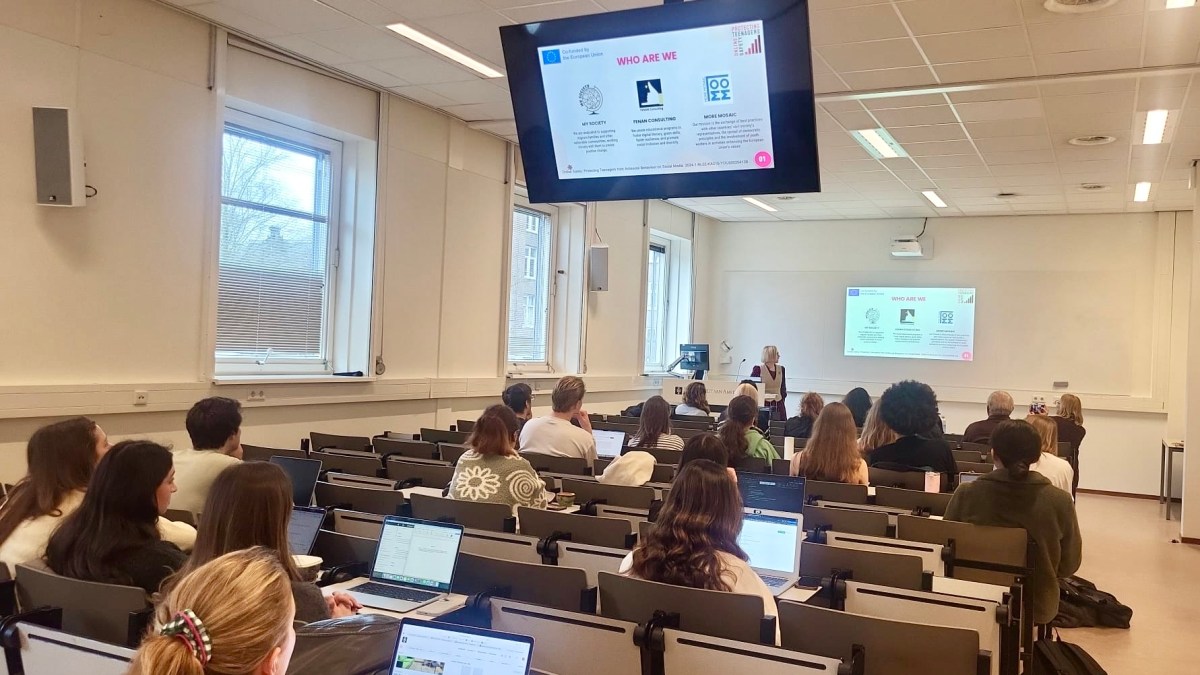
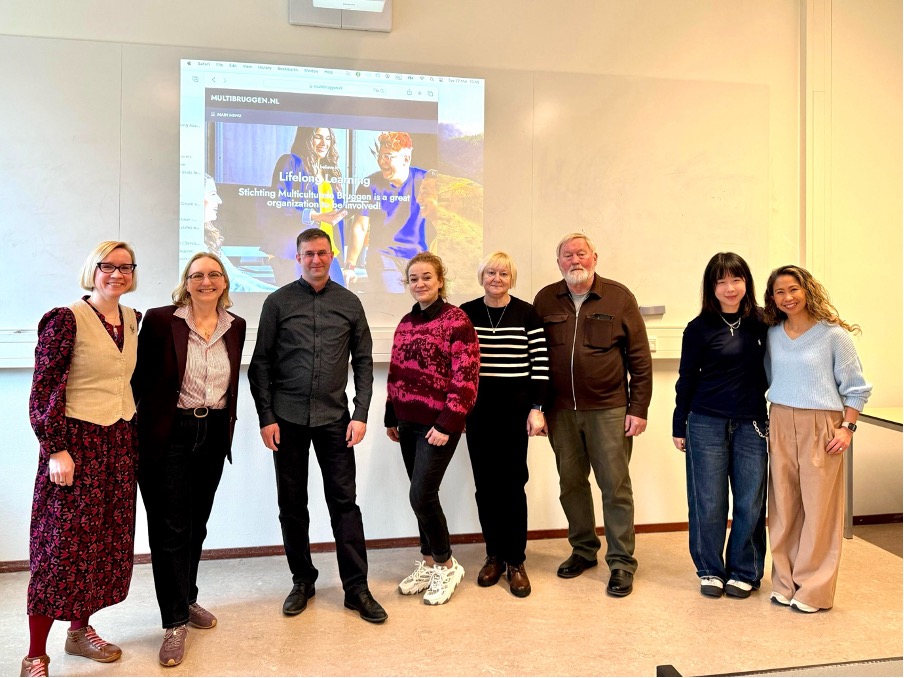
The Online Safety for Teenagers project was recently presented at the Psychology of Misinformation Symposium, hosted by the University of Amsterdam. The event brought together a diverse audience of Communication Science students, academic researchers, youth organisations, and educators working in creative fields. This interdisciplinary setting created a valuable space for dialogue on how misinformation, online behaviour, and youth engagement intersect.
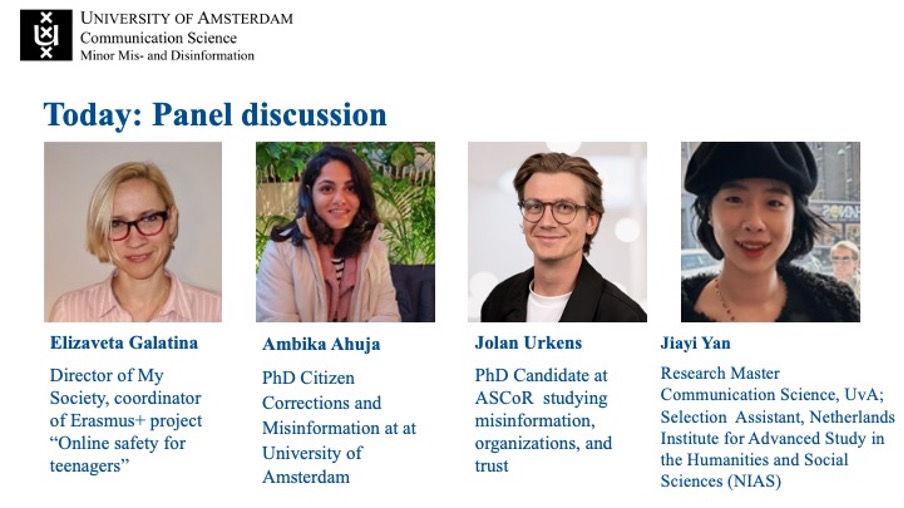
The session featured contributions from:
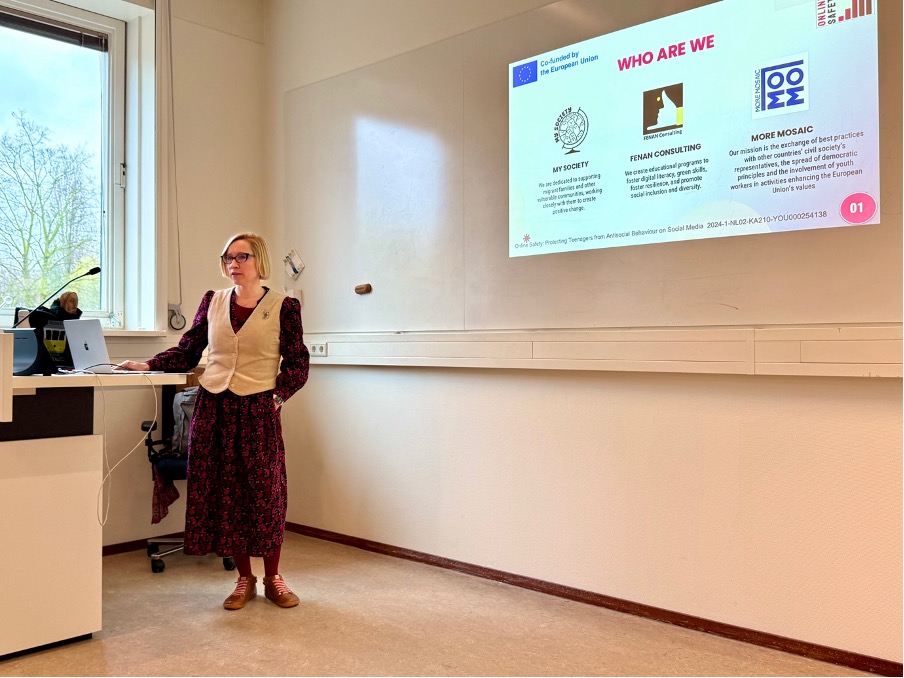
- Elizaveta Galatina, Director of My Society and coordinator of the Erasmus+ project Online Safety for Teenagers
- Ambika Ahuja, PhD researcher on citizen corrections and misinformation (University of Amsterdam)
- Jolan Urkens, PhD candidate at ASCoR focusing on misinformation, organisations, and trust
- Jiayi Yan, Research Master student in Communication Science (UvA) and Selection Assistant at NIAS
Bridging Research and Practice
A central strength of the symposium was its combination of theoretical insight and applied practice. While academic speakers explored mechanisms of misinformation and trust, Elizaveta Galatina’s presentation grounded the discussion in real-world youth work and intervention design.
Her contribution focused on the Erasmus+ project Online Safety: Protecting Teenagers from Antisocial Behaviour on Social Media, highlighting both empirical findings and practical tools developed through the project.
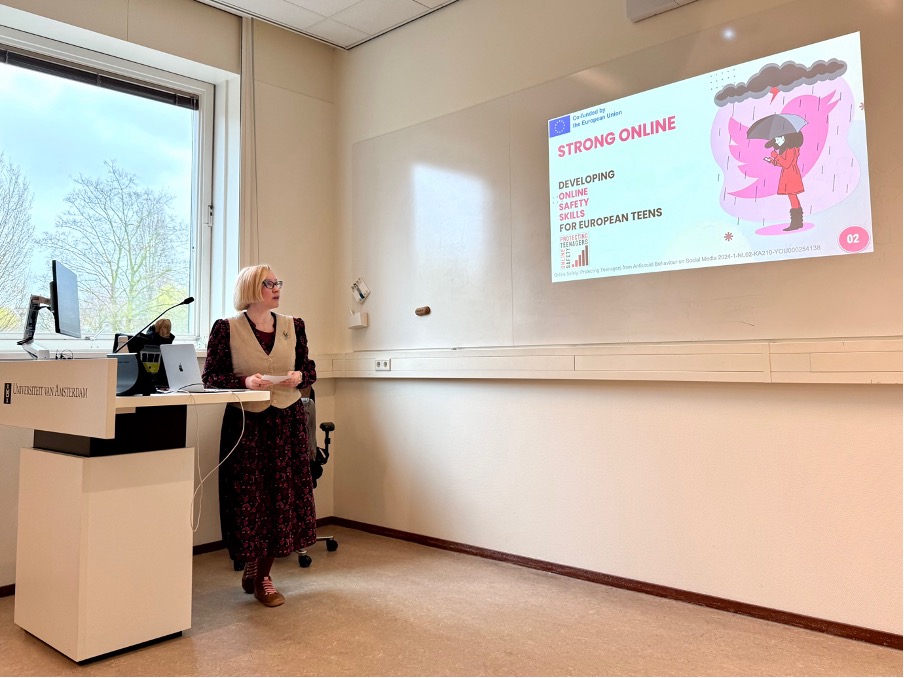
What Teenagers Experience Online
One of the most striking insights presented was the prevalence of harmful online experiences among teenagers. Project data shows that:
- Only 23% of teenagers reported never experiencing unwanted behaviour online
This finding reinforces a critical point often discussed in misinformation research: exposure to harmful or manipulative content is not an exception—it is a norm for many young people.
The presentation also addressed the ongoing policy debate around social media bans for minors, contrasting institutional approaches with teenagers’ own perspectives. Key takeaways included:
- Bans are often easily bypassed
- Social media is deeply embedded in identity formation
- Teenagers prefer education and guidance over restriction
- Young people want to actively participate in designing solutions
This aligns closely with contemporary communication science research, which emphasises participatory approaches and media literacy over top-down control.
From Problem to Intervention: Nonviolent Communication (NVC)
A major focus of the presentation was a practical intervention tested within the project: Nonviolent Communication (NVC) as a tool to reduce online aggression.
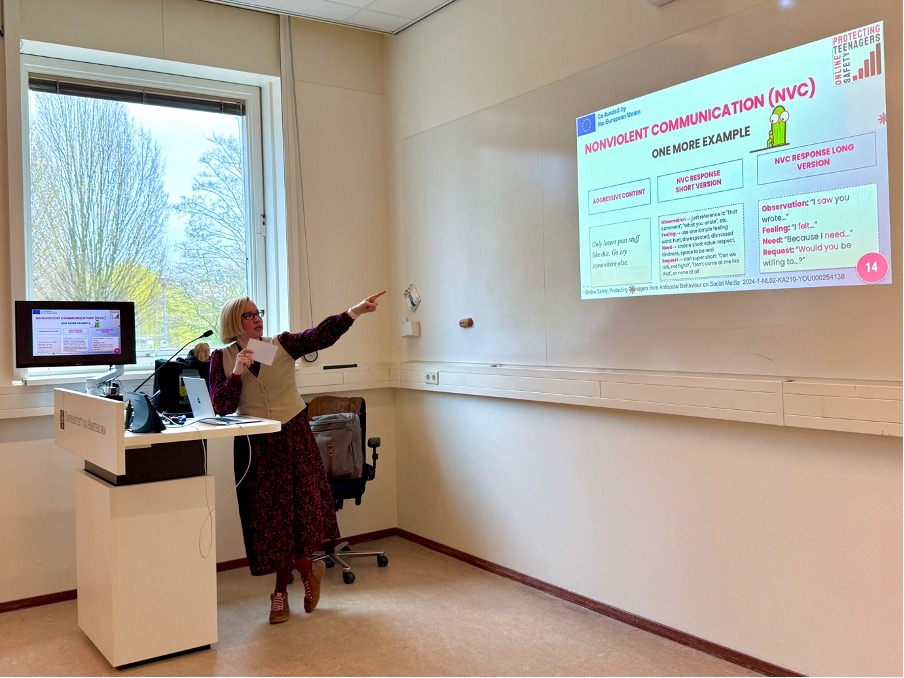
The approach introduces a simple response structure:
- Observation
- Feeling
- Need
- Request
Rather than escalating conflict, teenagers are encouraged to articulate emotional responses and set boundaries constructively. For example, instead of replying with insults, a response might reframe the interaction:
- Express how the comment felt
- Emphasize the need for respectful dialogue
- Invite a more constructive exchange
This method is particularly relevant in the context of misinformation, where emotionally charged interactions often amplify polarisation and reduce openness to correction.
Testing and Implementation
The presentation also outlined concrete project outputs:
- Pilot workshops conducted in the Netherlands and Sweden
- Development of an educational programme for youth workers
- Creation of tools to support teenagers in navigating antisocial online behaviour
This implementation-oriented approach was particularly well received by educators and youth practitioners attending the symposium, who are often seeking actionable methods rather than purely theoretical frameworks.
Why This Matters for Misinformation Research
Addressing misinformation is not only about correcting false content. It is about transforming the social dynamics of online interaction.
Aggression, identity, and emotional responses play a central role in how misinformation spreads and persists. By equipping young people with communication tools that foster respect and reflection, interventions like NVC may indirectly strengthen resilience against misinformation.
The symposium demonstrated the value of collaboration between academia and practice. For the Online Safety for Teenagers project, it also opened opportunities to:
- Further validate intervention methods through research partnerships
- Integrate communication science insights into training materials
- Expand dissemination among educators and youth organisations
These exchanges are essential for ensuring that solutions are both evidence-based and practically applicable.
 Online Safety